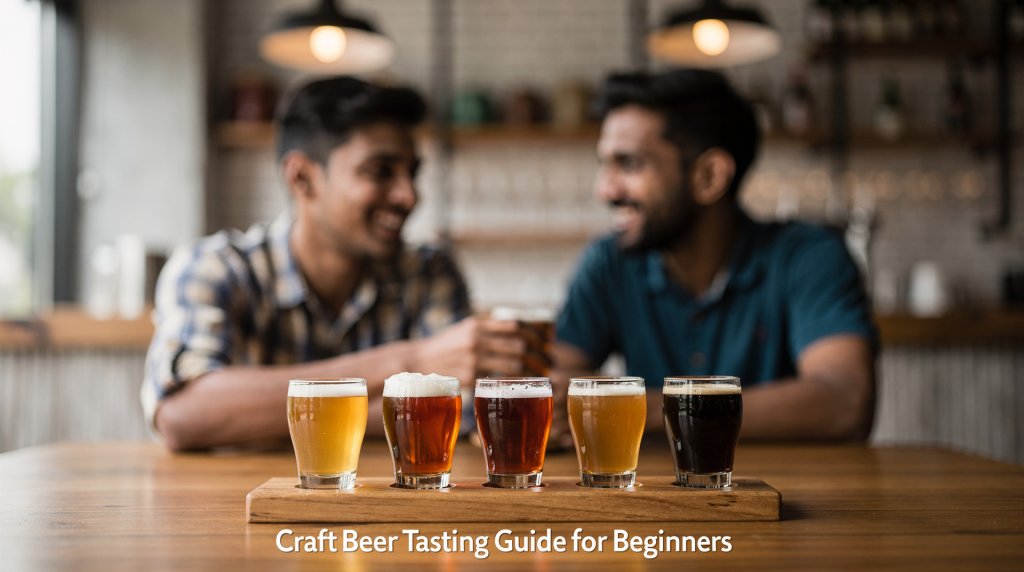
Craft beer tasting is less about acting like an expert and more about learning how to notice what is already in the glass. But once you start tasting with intention, something unexpected happens: you start reading the neighbourhood that produced it. When a local brewery uses kokum from the Konkan coast or jaggery from a nearby village, the beer becomes a story about soil, community and everyday life — and that’s exactly what I’ve witnessed on dozens of neighbourhood walks during the Grandview Dig Fest. If you are new to craft beer, the fastest way to improve is to taste in a simple, repeatable way: look, smell, sip, compare, and write down what you notice. Once that becomes second nature, you’ll not only find your favourite styles, you’ll also uncover a new lens through which to understand the pulse of any locality.
Why a tasting guide matters
Many first-time drinkers judge beer only by whether it feels “strong” or “light.” That misses most of the experience — and it’s a bit like deciding on a neighbourhood solely by property rates. A good tasting approach helps you understand aroma, bitterness, sweetness, mouthfeel, and finish, so you can tell the difference between a well-made lager, a fruity wheat beer, a hop-forward pale ale, or a rich stout. A tasting paddle is especially useful because comparing small pours teaches you faster than finishing one full pint and moving on. The same logic applies when you’re exploring a new residential block: strolling through three lanes in quick succession reveals far more about street life, noise levels and community warmth than spending an entire afternoon on just one corner. During the early days of the fest, I watched residents who’d never thought much about beer suddenly start talking about what they tasted — and then, almost without effort, they began describing the character of their own blocks, the spice markets they passed daily, and even the old bakery that had been there for generations. A tasting guide is that first bridge between the glass and the street.
The beginner’s beer tasting method
The simplest method is to follow four steps: look, smell, taste, and finish. This works for almost any style and is easy to use at a brewery, beer bar, or home tasting session. I’ve used it standing in garages-turned-taprooms tucked behind corner temples, and on rooftops overlooking bazaar lanes that themselves smell like malt and jasmine. Here is how to make it a ritual that connects you to where you are.
1) Look at the beer
Hold the glass against light and observe:
- Colour: pale straw, gold, amber, brown, or black
- Clarity: clear, hazy, or opaque
- Foam: thin, dense, stable, or quickly fading
- Carbonation: lively bubbles or a softer pour
A beer’s appearance is not just decoration. It often gives you clues about body and style. For example, wheat beers are often hazier, while lagers are usually clearer. A stable head can also help trap aroma. On a neighbourhood level, the colour and clarity of a local brew can hint at the water source, the grain sheds in the nearby industrial estate, or even the community hall where the brewers first experimented. In one Goan lane, a hazy wheat beer reminded me of the fog that rolls in from the river every December — a visual cue the brewer had grown up with and intentionally recreated.
2) Smell before sipping
Bring the glass close and take a few short sniffs. Swirl gently first if needed.
Pay attention to:
- Malt notes: bread, biscuit, toast, caramel, honey
- Hop notes: citrus, pine, grass, flowers, tropical fruit
- Yeast notes: banana, clove, spice, pepper
- Off-aromas: cardboard, butter, sourness, metallic notes
Aroma matters because a lot of what we call “taste” actually comes from smell. If the beer smells dull, stale, or oddly sweet, that is useful information too. Think of it as walking into a home for the first time: before you notice room sizes, you register the smell — fresh paint, old wood, drying spices, or dampness. The nose never lies. During a fest walk through a Pune peth area, a local brewer asked us to compare the scent of his IPA with the dry, citrusy peel vendors sold on the footpath a few metres away. The connection was immediate, and suddenly everyone in the group understood that beer is not an abstract product; it’s a distillation of what already exists around the corner.
3) Take a small sip and let it spread
Do not gulp the first sip. Let it coat your tongue and note what happens in stages:
- First impression: sweet, bitter, dry, fruity, spicy, roasty
- Mid-palate: body, texture, balance, flavour depth
- Aftertaste: clean, lingering, harsh, dry, warming
Try to separate flavour from texture. A beer can taste light but feel creamy, or taste sweet but finish dry. In a similar way, a locality can look chaotic but feel serene once you walk past the main road. I’ve learned to read neighbourhoods exactly like this: first impression is the arterial road, mid-palate is the inner lane, and the aftertaste is how you feel walking back to your home after an evening stroll. When I guide newcomers through a tasting, I often pair each sip with a few steps through a real lane — the pace forces you to slow down and notice what’s actually around you.
4) Notice the finish
The finish is what remains after swallowing.
Ask yourself:
- Does the flavour fade cleanly?
- Does bitterness linger pleasantly or aggressively?
- Is the aftertaste refreshing, sweet, dry, or burnt?
- Would you take another sip right away?
A clean finish usually suggests balance. A harsh, overly bitter, or papery finish may point to a flawed pour or a beer that is past its best. It’s a bit like the way a neighbourhood sits with you after you’ve visited: a balanced community leaves a clean, welcoming feeling; an uncomfortable one keeps prickling long after you’ve left. When I’m evaluating both beer and potential homes, I pay close attention to what remains — because that’s what you’ll live with day after day.
What to taste for in different beer styles
If you are just starting out, learn styles by contrast. In India, that often means starting with accessible beers and then trying more aromatic or intense options. But there’s also a regional dimension worth noting: a lager served at a Delhi social is often crisper and more straightforward, while a wheat beer from a small Mumbai microbrewery may carry whispers of the coastal humidity and local bananas. Here are the broad strokes.
| Style | What it usually tastes like | Best for beginners who want |
|---|---|---|
| Lager | Crisp, clean, mild bitterness | A simple, easy entry point |
| Wheat beer | Soft body, banana, clove, citrus | Fruity aroma and gentle spice |
| Pale ale | Hop aroma, moderate bitterness | A more flavourful but approachable beer |
| IPA | Strong hop character, citrus, pine, tropical notes | A bold, aromatic experience |
| Stout | Roast, coffee, cocoa, dark malt | Richer, deeper flavours |
A beginner does not need to love every style. The goal is to learn what you enjoy and why. When I take people through this table during a fest, I encourage them to notice whether the beer reminds them of anything local — a bakery, a spice shop, a monsoon petrichor. Once you start linking flavour to place, you’re well on your way to understanding not just beer, but the neighbourhoods that shape it.
How to build your palate step by step
If you are new to craft beer, start with approachable styles and move gradually toward stronger flavours. This is exactly the same principle I recommend to house-hunters: explore a locality from its quiet edges before diving into its loudest market. You need a baseline of calm to appreciate the full spectrum.
A simple tasting order
- Start with a lager or wheat beer.
- Move to a pale ale.
- Try an IPA.
- Finish with a stout or darker ale.
This order works because lighter beers won’t get buried by stronger bitterness or roast. If you start with a heavy IPA, a delicate lager may seem bland afterward. I’ve seen countless visitors at fest walkabouts make the mistake of jumping headfirst into a double IPA and then dismissing an excellent rice lager as “watery” simply because their palate had been bulldozed. The same happens when people see only chaotic traffic in a ward and miss the quiet gully with a community library three lanes down. Order matters, in both tasting and touring.
A practical first tasting flight
A good beginner flight can include:
- 1 crisp lager
- 1 wheat beer
- 1 pale ale
- 1 stout
Taste them side by side in small pours. Write one or two words for each beer. Over time, those notes become a personal flavour map. I often suggest to recently relocated families that they do something similar with their new ward: pick four landmarks — a tea stall, a park, a market lane, a place of worship — and jot down one sensory word for each. It’s the same principle of deliberate comparison that helps you find not just a house, but a home.
How to take tasting notes
You do not need fancy vocabulary. Use words you already know. The best notes I’ve ever read came from a retired schoolteacher during a fest workshop; she described a pale ale as “the colour of evening sunlight hitting our compound wall” and the finish as “like the silence after a temple bell.” That’s far more useful than “stone fruit with resinous pine.”
A simple note format
- Appearance: clear, hazy, dark, bright foam
- Aroma: citrus, bread, banana, roast, floral
- Taste: sweet, bitter, fruity, spicy, malty
- Mouthfeel: light, medium, creamy, dry, fizzy
- Finish: short, clean, bitter, lingering, warming
Example:
- Pale ale
- Golden and clear
- Citrus, pine, light toast
- Bitter up front, then a little bready
- Medium body, lively carbonation
- Dry finish, easy to keep drinking
This kind of note is enough to help you remember what you liked and what to order next time. The same structure works surprisingly well for recording your impressions of residential pockets: “appearance” becomes the look of the street, “aroma” the smell of the air, “taste” the feel of the community, and “finish” that lingering sense of whether you’d want to live there.
Pairing beer with food in India
Beer tasting becomes easier when paired with food that does not overwhelm it. Food is also the quickest way to decode a neighbourhood’s identity — the small thela outside a local brewery often defines the area more than any real estate brochure. When I design a tasting walk, I always include a short food stop where a resident shares a plate of something traditionally made just a street away.
Good beginner pairings
- Lager: fries, salted peanuts, pakoras
- Wheat beer: chicken tikka, light salads, soft cheeses
- Pale ale: kebabs, grilled paneer, masala peanuts
- IPA: spicy fried snacks, burgers, tandoori dishes
- Stout: chocolate desserts, roasted meats, BBQ
In Indian settings, very spicy food can flatten subtle beer flavours. If the dish is intense, choose a beer with enough character to hold up. I’ve seen this play out in countless community gatherings where a delicate lager was served alongside fiery Andhra chilli chicken — the beer vanished under the heat. A local brewer once told me that he designs his IPL specifically to stand up to the mirchi bajjis sold at the gate of his colony. That kind of micro-pairing is a reflection of deep local knowledge, and it’s exactly the sort of detail that helps you understand whether a neighbourhood has a culture of eating, drinking, and living well together.
Common mistakes beginners make
Drinking too cold
Very cold beer can hide aroma and flavour. If it tastes muted, it may simply be too cold. Let it sit for a few minutes and taste again. In a similar vein, I’ve watched home-hunters rush through a locality in an air-conditioned car with windows rolled up — they never feel the real texture of the place. Warm it up a little, both the glass and your approach.
Skipping the smell
If you go straight to drinking, you miss a large part of the experience. Smell first every time. The same rule applies when you walk into a potential home: that first whiff of the room, the corridor, the stairwell — it tells you things a floor plan cannot.
Starting with the strongest style
An aggressive IPA or heavy stout can overwhelm your palate early. Begin with lighter beers. The new family I met last monsoon made a parallel mistake: they began their area search with the busiest commercial hub, and it took them weeks to discover that five minutes away there was a quiet residential pocket with a community garden. Start gentle, then explore intensity.
Using flavoured snacks as a palate cleanser
Spicy chips, masala snacks, and strong chutneys can distort the next beer. Water and plain crackers work better. The neighbourhood equivalent? Don’t let a single loud incident — a festival, a road rage moment — colour your judgment of an entire block. Cleanse your impression with a quiet early morning stroll before drawing conclusions.
Forcing vocabulary
You do not need to say “notes of stone fruit and resinous pine” if all you notice is “orange peel and bitter.” Honest notes are better than decorative ones. And when you’re describing a locality to a friend, “the lane where the aunty feeds the cats” is far more valuable than “a vibrant urban ecosystem with robust community engagement.” Real language builds real connections.
What good beer quality looks like
A beginner can spot a few useful quality signs without any technical training:
- The beer smells fresh, not stale
- The foam is present and stable enough to support aroma
- The flavour feels balanced, not one-dimensional
- The finish is clean, not harsh or papery
- The beer tastes like the style it claims to be
If something seems wrong, it could be the beer, the glass, or the serving temperature. Do not assume your palate is the problem. The same compassion is needed when you’re evaluating a neighbourhood. If something feels off — a disconnect between what you expected and what you see — it could be the time of day, the season, or a recent civic disruption. I always revisit a lane three times: once on a weekday afternoon, once on a Sunday morning, and once during a local festival, if possible. That’s how quality reveals itself.
A beginner’s tasting checklist
Use this before or during a beer tasting:
- Choose 3–4 small pours, not full pints
- Start with lighter styles
- Use a clean glass
- Look at colour and foam
- Smell before sipping
- Take small, deliberate sips
- Note sweetness, bitterness, body, and finish
- Drink water between samples
- Cleanse the palate with plain crackers if needed
- Record what you liked and disliked
Print this out and carry it on your next neighbourhood exploration. Replace “beer” with “block” in your mind, and the steps still hold: select a few pockets, observe, take small notes, drink water (rest your eyes), and record honest reactions. This is how I’ve built my own hyperlocal guides — methodically and with a beginner’s curiosity.
Best way to practice at home
You do not need a brewery visit to learn. Buy two or three different styles and compare them in small glasses. Taste them in this order: lightest to strongest. Keep the room neutral, use simple food, and avoid strong perfumes or scented candles, which can interfere with aroma.
A useful home exercise is to compare two beers from the same style. For example, two wheat beers or two pale ales. That helps you see how much variation exists even within one category. The same exercise can be done with your own locality: compare two parallel streets with the same built density and notice the differences in light, sound, and neighbourly rhythm. You’ll be astonished at what you discover.
When to slow down or stop
Beer tasting is not about drinking as fast as possible. If the alcohol starts dulling your senses, pause. Drink water, eat something plain, and stop if your palate is no longer giving clear signals. A tired palate cannot judge flavour well. The same rule applies when you’re neighbourhood-hopping for hours. Decision fatigue sets in, and every lane starts to look the same. I always limit my house-hunting walks to three locations a day, with a proper lunch break in between. Respect your senses; they’re your most reliable guides.
FAQ
What is the easiest craft beer style for beginners?
Lager and wheat beer are usually the easiest starting points because they are approachable, balanced, and less intense than hop-heavy styles. If you’re completely new, find a local microbrewery that also has a community noticeboard or hosts a small weekend market — that way, your first tasting also introduces you to the local pulse.
How many beers should I taste in one session?
Three to four small pours are ideal for beginners. More than that can make it harder to notice differences. I’ve found the same number works for visiting open houses: too many and the details blur.
Should I use a special glass?
A tulip or snifter can help concentrate aroma, but a clean standard glass works fine for beginners. Many neighbourhood taprooms will serve in whatever they have — often a sturdy glass that’s part of the local chai culture. Use it. The context is part of the experience.
What should I write down during tasting?
Note appearance, aroma, taste, mouthfeel, and finish in simple words. Short notes are more useful than elaborate descriptions. This habit also helps when you’re comparing rental properties: a few honest, sensory notes are worth a thousand glossy photos.
How do I know if I dislike beer or just that style?
Try the same style from a different brewery, then compare it with a lighter or more familiar beer. Sometimes the style is the issue; sometimes it is the specific brew. The same diagnostic works for neighbourhoods: if a you don’t feel comfortable in one part of a city, try a different precinct before deciding the whole city isn’t for you.
Final thoughts
The best craft beer tasting guide for beginners is simple: start light, smell carefully, sip slowly, and compare with intention. Once you learn to notice aroma, balance, body, and finish, every beer becomes easier to understand—and much more enjoyable. But there’s a bigger reward. When you apply that same deliberate noticing to the streets around you, you start seeing your neighbourhood not as a mere address, but as a living, evolving story. That’s the real spirit Grandview Dig Fest uncovered: the way a well-tasted beer can make you feel more at home, and the way a well-understood locality can make every sip richer. So pour a small glass, step outside, and begin.